
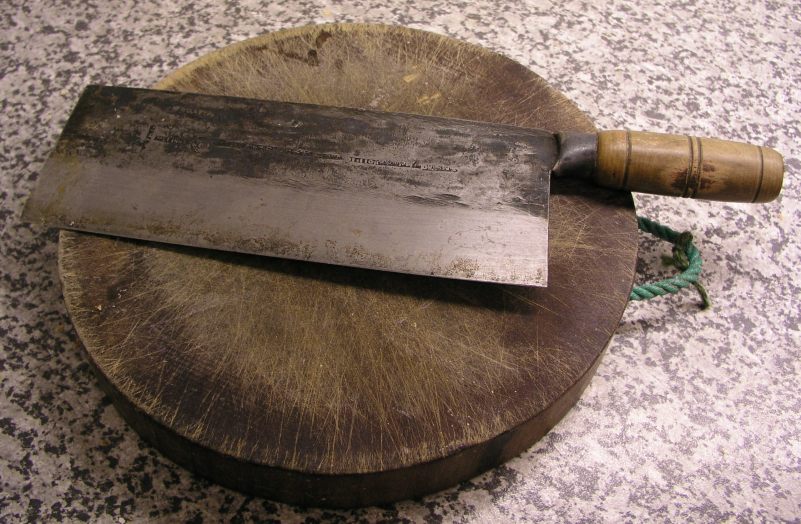
Chinese kitchen knife on cutting board. Illustrative photo, not the competition knife. “Chinees hakmessmall.jpg” by Evanherk, via Wikimedia Commons, CC BY-SA 3.0. The image is unaltered.

A large, rectangular kitchen blade does not have to be heavy. At Knife Show Austria, knifemaker Ambros won a cleaver challenge with an entry weighing just 167 grams. For those of us who like making knives, it is a good opportunity to take a closer look at thickness, balance, and where we really need the steel.
167 grams. It is easy to read the number and move on. But draw a knife blade that is 20 centimeters long and 10 centimeters high on a piece of paper, and you will get a better impression of the size the competition was based on.
This is a lot of blade surface to keep the weight down.
In the review after Knife Show Austria on October 24–25, Ambros, known as @ambros_knives, is highlighted as the winner. Organizer Martin Huber states that the weight was 167 grams and says that he provided the material, while Ambros did the work. (Kitchen Knife Forums)
A challenge with clear parameters
According to participant Fabian Jäger, the competition knife was to be forged, fully functional, and have a blade measuring 200 × 100 millimeters. The steel was to be ApexUltra, either throughout the blade or as core steel in a laminated construction. In addition, the knife was to have a relatively low sharpening angle.
Jäger himself described the challenge of forging such a thin blade: The risk of ending up with a warped blade after heat treatment was part of the calculation. (Kitchen Knife Forums)
This makes the competition interesting also for those who have never intended to make a cleaver. Here, material selection, forging, heat treatment, and sharpening must work together.
What does “cleaver” actually mean?
In Norwegian, it is tempting to translate the word as meat cleaver. But the wide, rectangular shape does not alone tell what the knife can withstand or is intended for.
Such a blade can also be a thin kitchen knife for precise cutting work. If the knife is to be used for heavy-duty tasks, the construction must be designed for it. The shape alone is no user manual.
For the knifemaker, the first question is therefore: What is this knife going to do?
The answer should determine how thick the edge should be, how the blade is sharpened, and how much material is retained.
The lesson lies in the geometry
We often spend a lot of time choosing steel. It is an enjoyable part of the hobby, and there are plenty of properties to compare.
But the steel must also be given a shape that suits the task.
Metallurg Larrin Thomas highlights that a good combination of steel and heat treatment can make it possible to use a thinner edge geometry. At the same time, even very good steel and good heat treatment cannot compensate for a geometry that is poorly suited to the cutting work. (Knife Steel Nerds)
It is useful to keep in mind at the belt sander. How much resistance does the blade meet when it goes through the raw material? Do you need more support behind the edge, or have you retained more material than the task requires?
Low overall weight and good cutting ability are also not the same. A light knife can still be thick where it matters most for the cut.
From an Austrian competition to a Norwegian workbench
Whether you make bushcraft knives with a hidden tang, or fit handles on ready-made kitchen knife blades, you can take the same curiosity into the next project.
Try to determine the use before you determine all the details. Feel free to make a simple model of the handle, and feel how the size and grip fit the blade. Weigh the parts along the way, and investigate how the handle and tang affect the balance.
You do not need to aim for 167 grams. A knife that fits well in the hand and works for the task is a better goal for a regular utility project.
The winning entry from Austria is first and foremost an exciting craftsmanship achievement. The reported weight does not alone tell how the knife cuts or holds the edge over time.
But it gives us a good workshop challenge: How much material does your next knife need – and where does it need it?
Would you like to try making a kitchen knife handle? In our guide to making your own knife handle, you will find tips on material selection, shape, and procedure.

Commenta
Nota che i commenti devono essere approvati prima di essere pubblicati.
Questo sito è protetto da hCaptcha e applica le Norme sulla privacy e i Termini di servizio di hCaptcha.